The problem
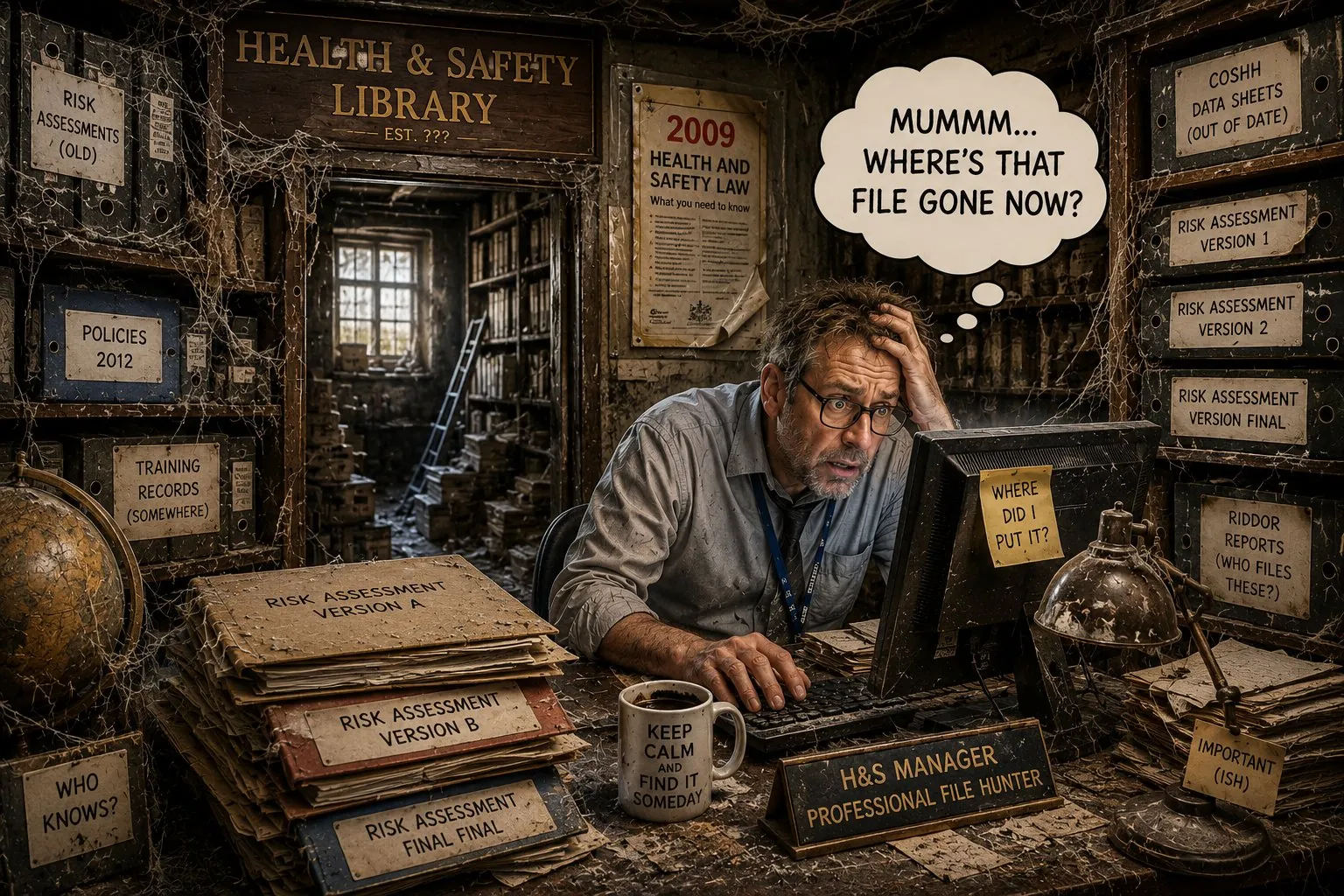
Every H&S manager knows the feeling. First week in a new role, or first visit to a new client. You ask for the health and safety documentation. What arrives is not a system. It is an archaeology project.
A folder from HR containing a policy dated four years ago. A risk assessment emailed over by the previous production manager, saved on his personal drive, which nobody has accessed since he left. Fire safety records held by the facilities team in a format nobody else uses. COSHH data sheets in a lever arch file on a shelf in the stores. Training records split across three different spreadsheets maintained by three different departments, none of which talk to each other.
The documents exist. The compliance intention was there. But the system never was.
This is not a criticism of the people who built it. It is what happens when health and safety documentation grows organically across an organisation over years, attached to whoever happened to be responsible for each area at the time. Finance holds what finance touched. Maintenance holds what maintenance touched. HR holds what HR touched. Nobody holds all of it, and nobody can find all of it when they need it.
At audit, this costs hours. At incident investigation, it costs more than that.
The burden
The administrative drag of an unstructured H&S document estate is rarely counted, but it is constant.
A manager trying to demonstrate compliance at short notice faces a retrieval problem before they face a compliance problem. They are not asking whether the risk assessment is suitable and sufficient. They are asking where the risk assessment is. Those are different questions, and the second one should not exist.
Time spent locating documents is time not spent managing risk. Every version control failure, every document held in a personal inbox, every risk assessment that exists in two slightly different versions in two different locations, adds friction and creates doubt. When an incident happens and the investigation asks for the training record or the safe system of work, the answer needs to be immediate. It rarely is.
The invisible cost is continuity. When a manager leaves, the system leaves with them. The next person starts again from nothing.
The solution
The solution is not a new software package. It is structure. And the starting point does not have to be a blank page.
Before building the folder structure, describe your working environment to an AI tool. Sector, size, activities, the legislation you know applies. Ask it to generate a numbered H&S topic taxonomy for an organisation like yours. It will return a draft list in minutes. Treat that list as a starting point, not a source. Anything legal gets checked against legislation.gov.uk and HSE guidance before it goes in.
What you do next is the practitioner's job. You review the list. You correct what is wrong. You add what the AI missed because it has never walked your site or spoken to your workforce. You remove what does not apply. You end up with a structure that is yours, grounded in legislation, and built in a fraction of the time it would have taken from scratch. That is not AI doing the work. It is AI removing the blank page, so the practitioner can spend their time on the part that needs one.
A numbered folder taxonomy is then built in Google Drive and shared across the organisation as a read only hub for all staff, with edit access controlled by the H&S function. Every topic has a home before the document is written. Every document lands in the right place the moment it is created.
This is not a migration project. Documents do not need to move. Finance keeps its files in finance. HR keeps its files in HR. Maintenance keeps what maintenance has always kept. The H&S hub holds a linked index that points to all of it. One place to look, regardless of where the document actually lives. You are building a library catalogue, not relocating the books. Nobody loses ownership of their files, nobody changes their working habits, and there is usually little or no case to make to IT.
The folder number also becomes the document reference prefix. Folder 03 is COSHH and waste management, so every document in that folder carries FD03 in its reference number. FD03-COSHH-001 is the first COSHH document. Anyone reading that reference knows which folder it lives in before they open Drive. The structure and the document management system are the same system.
The outcome
The difference is visible the first time someone asks for something.
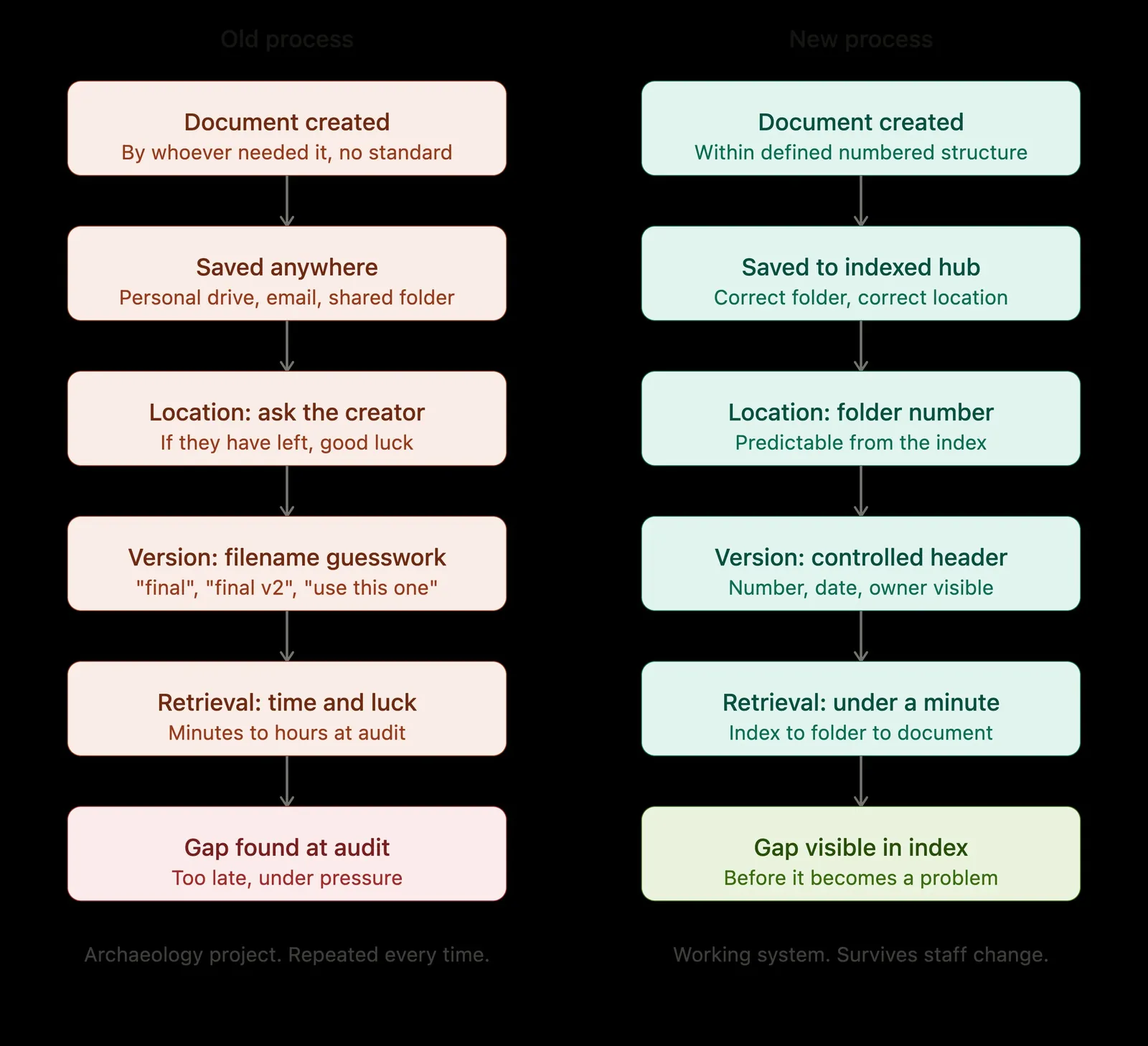
The auditor asks for the current COSHH register, three risk assessments, and evidence of training. Under the old arrangement, finding them takes most of the morning. Under the indexed structure, the same evidence is produced before the first cup of tea is finished.
For the incoming H&S manager, there is nothing to dig through. The predecessor's work is visible, attributable, and assessable from day one. Gaps are gaps in the system, not gaps in knowledge of where to look.
For the organisation, continuity survives staff change. The system is held in the structure, not in a person.
The filing cabinet was never the answer. The filing cabinet was the problem. A structured, linked, numbered document hub does not need expensive software or specialist IT support, and once it is set up it takes little time to maintain. It needs a decision about where things live, made once, applied consistently.
That is what a working system looks like. Not on paper. On a wet Tuesday morning when the auditor turns up unannounced.
And when you hand it over, it does not go with you. The system stays. That is the point.
If your own H&S documentation has grown this way over the years, you are in good company. A second pair of eyes, used to looking at it this way, usually finds the structure already hiding underneath.
If you have read this far, the filing problem probably sounds familiar. A short conversation is usually enough to see where to start.