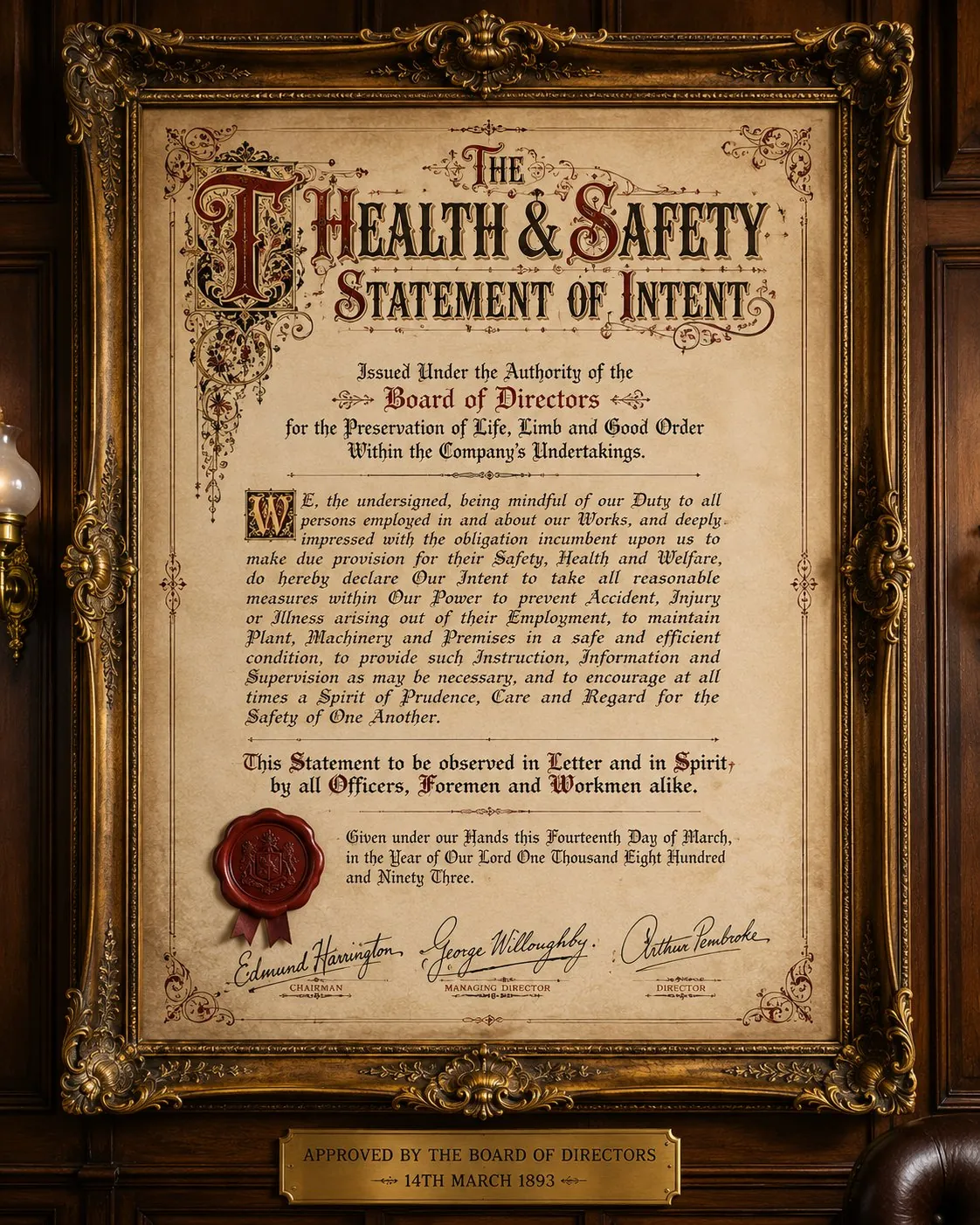
The problem
Every organisation with five or more employees must have a written health and safety policy. It is the document the law names directly, the statement of intent at the top of the whole system, the thing everything else hangs off.
And it is often the document least likely to have been read in years.
Many policies were written once and never truly revisited. Some were bought in as a template years ago, the company name dropped into the header. I have opened policies still carrying phrasing that was old when I started. Year after year, someone changes the date at the bottom and signs it. That is recorded as the annual review.
It is not a review. It is a signature on a document nobody opened.
The burden
In my experience, the annual review is one of the most commonly signed and least commonly performed tasks in health and safety. Almost everyone signs one. Almost nobody does one.
The reason is simple. Doing it properly means reading the whole thing, line by line, and asking of every line: is this still true. Do these named people still work here. Do these arrangements still exist. Is this still the law. That is slow, and it is dull, and changing the date satisfies an auditor glancing at the front page. So the date gets changed and the reading never happens.
The cost stays hidden until it does not. A policy that no longer describes how you work can do more harm than good, because it is likely to be one of the first documents an investigator reads. It names responsibilities nobody holds. It points to arrangements that were dropped years ago. It commits the organisation to things that never happen. The gap between what the policy says and what you actually do is the space an investigation moves through. You wrote it down. You signed it yourself.
The solution
Read it. Properly. That is the whole task, and it is the task that rarely gets done because there was never time.
There is now.
This is where AI earns its place, and it is the same method that runs through this series. Not because it writes a better policy than you could. Because it makes the read fast enough that it actually happens, and because of what it is reading against.
This only works if the work beneath it is done. A live legal register and an evidence library that mean something. Without those, there is nothing to check the policy against, and you are back to changing the date.
Give it what you have. The current policy. And give it the two things from the work already done: your legal register, and the evidence behind it. Then ask it to hold the policy up against both.
A template review could never do this, because a template has nothing to check against. Working against your register and your evidence, the tool does something different. It shows you where the policy and the reality have drifted apart. The responsibility named in the policy with no evidence it is being carried out. The arrangement the policy describes that the register has no proof for. The legal duty the register says applies that the policy never mentions. The role assigned to a job title that no longer exists.
It spots the section that says line managers carry out and record monthly inspections, then looks through the records you have given it for any sign those inspections actually happen. Only something cross referencing what the policy claims against what you can actually prove can hold it up to the light and show you where it is no longer telling the truth.
Then you do the part that is yours. You read what it found. You decide what is a real gap and what is noise. And you rewrite the policy to describe the organisation as it actually is now, anchored to the regulations that actually apply and the evidence you actually hold. The statement of intent that is true. The responsibilities held by people who exist. The arrangements that point to proof that is real.
The outcome
The difference shows the moment someone reads it who was not there when it was written.
A new manager, an auditor, an investigator. They open the policy and it describes the organisation they are standing in, not one that existed twenty years ago or one lifted from a template. The responsibilities match the people. The arrangements match the work. The policy points down into the register, the register points to the evidence, the evidence sits in the structure. Top to bottom, it agrees with itself.
And the review becomes real. Once a year, anchored to a register that is kept current, the policy gets read against the evidence and the gaps surface before anyone else finds them. Not a date change. A reading. The thing the signature was always supposed to mean.
A health and safety policy is not a certificate to hang on the wall. It is the top of a working system. The test is not whether it is signed. The test is whether it is true.
If your own policy has only ever had its date changed, you are far from alone. Reading it properly is something we can do with you.
If you have read this far, you may be thinking about your own policy. A short conversation is usually enough to tell whether it would hold up.