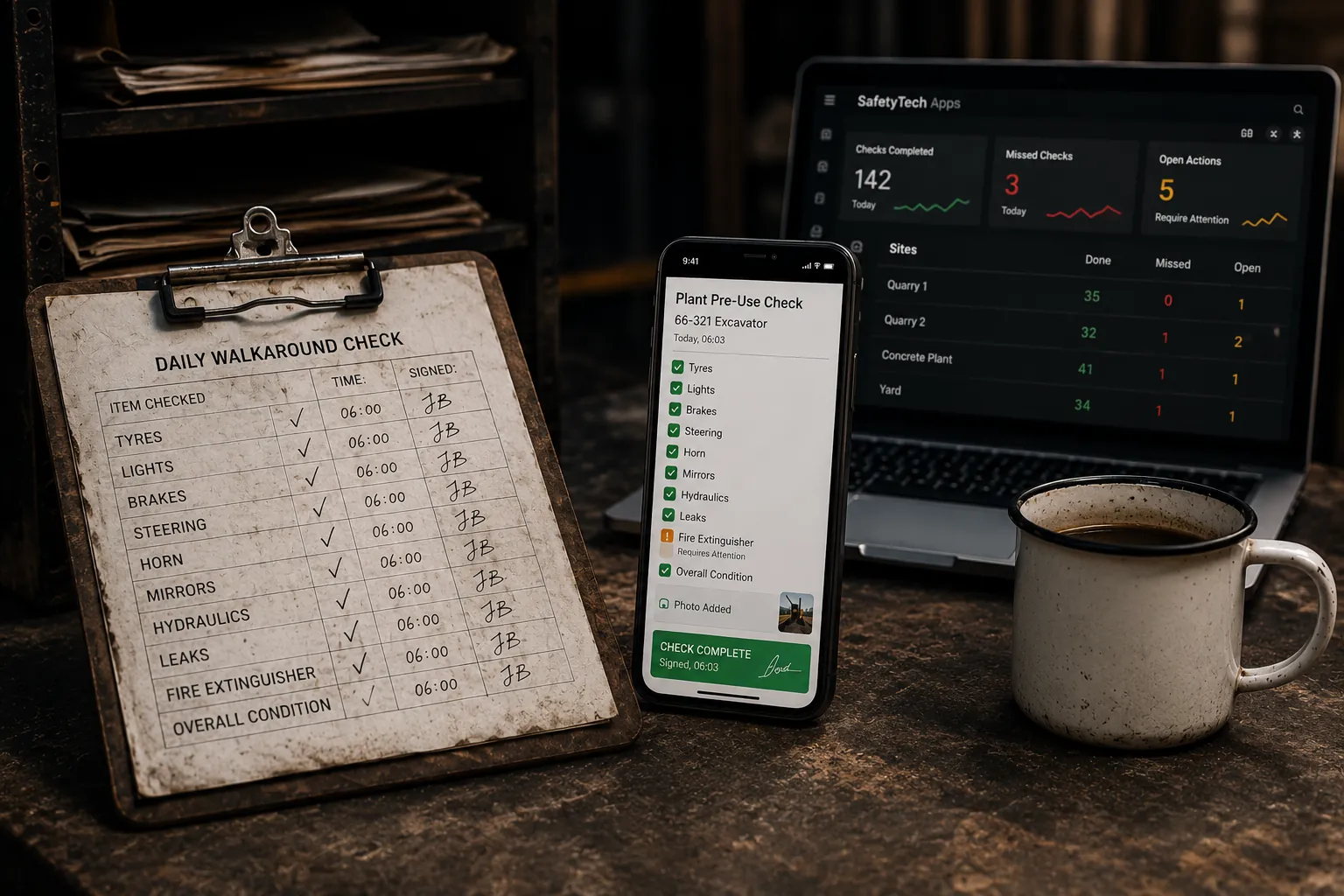
The problem
Every operation runs checks. The walkaround before the vehicle moves. The ladder tag. The fire door. The weekly plant inspection. Someone does them, shift after shift, and the proof is a tick on a sheet in the cab, a tag on the scaffold, a book in a drawer by the gate.
The check being done and someone knowing what it found are two different events.
Thirty years in the field taught me that safety rarely breaks in the policy. It breaks in that gap.
The burden
A tick tells you a box was ticked. It does not tell you the tyre was looked at, the guard was tried, the door was closed on. The sheet records the claim, not the check, and you cannot tell the two apart by reading it.
Worse is what happens when a check finds something real. The defect spotted at six in the morning sits in the cab until someone walks past the book, or until it fails at two in the afternoon, or until the investigation. The information existed. It never travelled.
And when it goes wrong, the walkaround sheet, filled in and signed, is likely to be one of the first things an investigator asks for. It shows the check was recorded. It cannot show the defect reached anyone in time to act. A check nobody sees changes nothing.
The solution
Same method as the rest of this series. Take the check that already happens, and close the gap between doing it and knowing what it found.
That means capturing the check at the source, the moment it happens, not copying it up from paper later. A QR code on the vehicle, the machine, the ladder. Scan, and the right checklist opens. Tick, a photo where it matters, a signature. The moment it is done it stops being a claim on a sheet and becomes structured evidence, stamped with the time and the place. A defect alerts the person who can act as it is logged. A missed check flags itself. A dashboard shows done, missed and open across every asset and site, live.
A digital tick can still be a claim. But a time and location stamp, and a photo where it matters, make it a lot harder to tick the box from the canteen.
AI removes the labour that used to make a system like that slow and expensive to build. The judgement stays with a competent person. Which duty applies, what a real check looks like on that asset, where the operation is exposed. In our case that is thirty years, and it is not something a model can supply on its own, which is why every checklist is anchored to the actual legal requirement rather than a generic template lifted off the internet. The tool does not do the check. A person still does the check and holds the judgement. What it removes is the distance between the finding and the person who can act on it.
The outcome
A defect found at the start of a shift can reach the person who can act before the asset turns a wheel. The manager stops rebuilding yesterday from a pile of paper and sees the operation as it is.
And when the auditor, the insurer or the investigator arrives, the evidence is not a book in a drawer proving a box was ticked. It is a time and location stamped record of the check, what it found, who it reached and what happened next, every part agreeing with the others.
A safety check is not paperwork for the file. It is information that has to reach someone who can act while acting still matters. The test is not whether the check was done. The test is whether anyone knew in time.
If your own checks are being done properly and still sitting in cabs and drawers where nobody sees them until it is too late, that is the normal state of paper, not a failing of your people. Closing that gap usually takes days, not months.
“Absolutely fantastic. Very happy with the end result.”
This field note became a working system. If the gap between the check and the knowing rings true, the fastest way to weigh it is to see the thing that closes it.