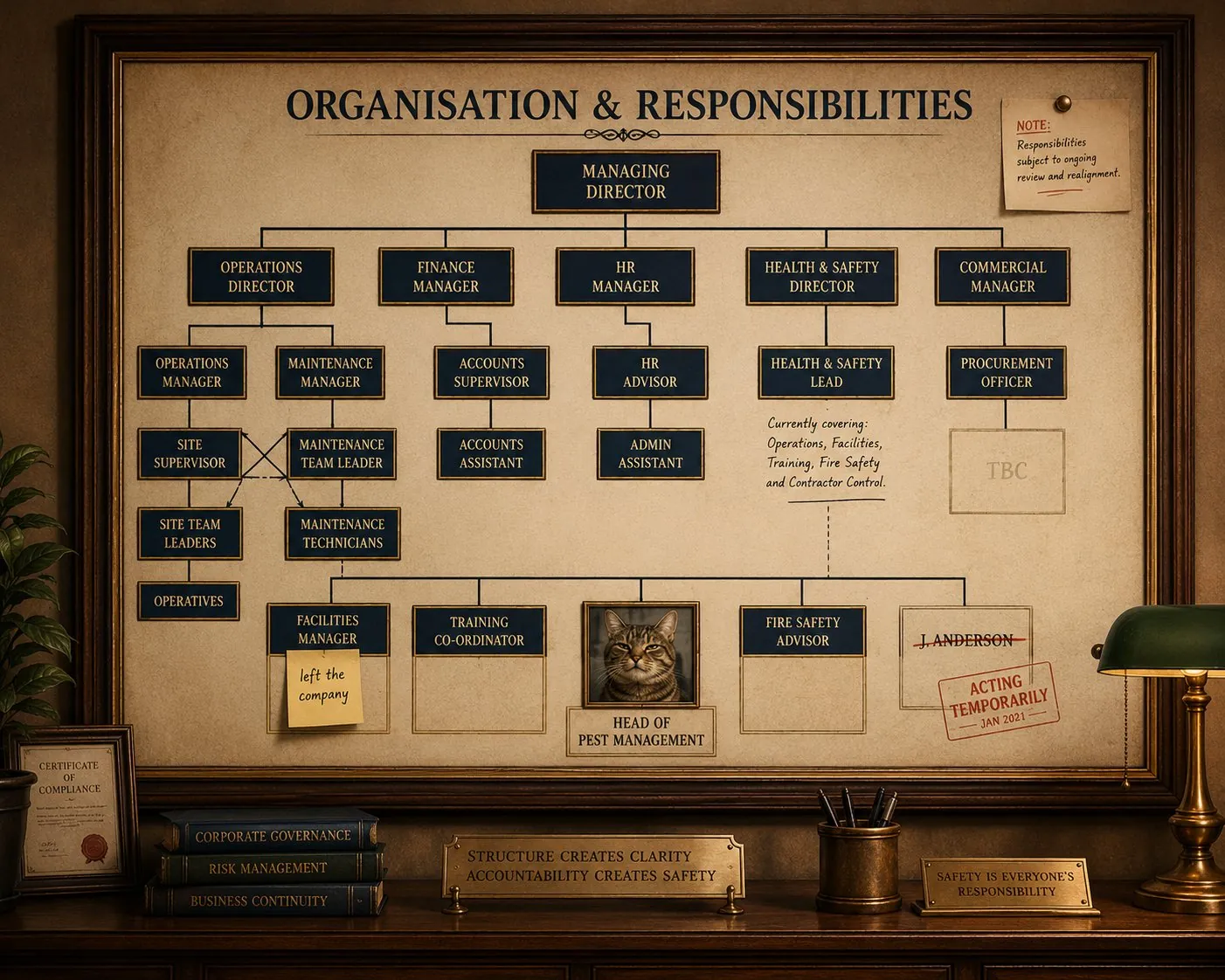
The problem
Every policy contains responsibilities. It is the section after the statement of intent, the one that says who does what.
The Managing Director shall. Managers shall. Supervisors shall. Employees shall.
It reads well. It looks like accountability. Every duty has a name above it and a line connecting it to the next.
Then you ask the simplest question in the building.
Who actually does it.
The burden
Responsibility assigned is not responsibility accepted. Those are two different things, and the policy only records the first.
The person named in the policy left three years ago. The task quietly migrated to someone else, or to nobody. The real expert, the one who actually understands the guarding on that machine or the permit system on that site, sits in maintenance or operations or HR. They sit in a box the chart never connected to the duty. The title on the page holds the responsibility. The person doing the work holds the competence. They are not always the same person, and sometimes they have never met.
The organisation chart says one thing. The organisation does another.
This stays invisible right up until it matters. When something goes wrong, the first question is who was responsible, and the policy answers immediately, confidently, and often wrongly. It names a role, not a person. A duty, not an owner. The investigation then finds the gap between the named responsibility and the accepted one, and that gap is where accountability falls through.
Nobody owned it because everybody was written down as owning it.
The solution
Stop describing responsibility as a list of titles and start mapping it to activities and evidence.
The method is the same one that runs through this series. Take the responsibilities the policy names. Hold them against the work that actually happens and the evidence that proves it. AI removes the labour. Given the policy and your records, it can read every "shall" and ask, for each one, where is the activity this refers to, and where is the record that shows it happening. It spots "Site Managers shall carry out weekly workplace inspections," then looks through the inspection records for ones actually carried out by people in those roles. Where it cannot find a match, it marks a gap to check, because a missing record is not always a missing inspection.
What comes back is not a tidier chart. It is a responsibility matrix tied to reality. Each duty linked to the activity it governs, the person who actually carries it out, and the evidence that shows it happening. The inspection that names a manager links to the inspection records signed by that manager. The training duty links to the training actually delivered. Where the link exists, someone is carrying the duty. Where it does not, you have found a duty that is assigned to a name and accepted by no one.
Then you do the part that is yours. You decide who should actually own each duty, based on who does the work and who has the competence, not who happened to have the right title when the policy was written. Responsibility without competence is not control. It is a liability. You put the real owner against the real activity. You connect the box in maintenance to the duty it has quietly been carrying for years. The chart stops being an idea of how the organisation is meant to run and becomes a record of how it actually runs.
The outcome
Start with the day something goes wrong.
When an incident happens, there is far less scramble to work out who owned the thing that failed, because that question was answered before the incident ever happened. The responsibility was mapped to a real person doing a real activity with real evidence behind it, not to a job title in a box. The person named is the person who accepted it, and they accepted it because it matched what they actually do.
It also holds in the quieter moments that matter just as much. A new starter can see what they own and where the proof of it lives. A manager taking over a team inherits a map, not a guess. An auditor asking "who is responsible for this" gets the same answer from the policy, the person, and the records, because all three were built to agree.
In a health and safety system, an organisation chart is not just a picture of who reports to whom. It is a record of who owns what, and can prove it. The test is not whether every duty has a name against it. The test is whether the name against it is true.
If your own organisation chart has drifted from who actually does the work, that is common, and fixable. Mapping it back to reality is the kind of thing we are here for.
If you have read this far, you have probably already thought of a name on your own chart. A short conversation is the easiest place to start closing the gap.