The problem
Many people in health and safety are worried that AI will be used to cheat online training. The concern is simple. Someone opens a course, hands it to an AI, pops off to play golf, and comes back later to a completed certificate and a CPD record for training they never did.
I wanted to know whether that concern was real, so I tested it.
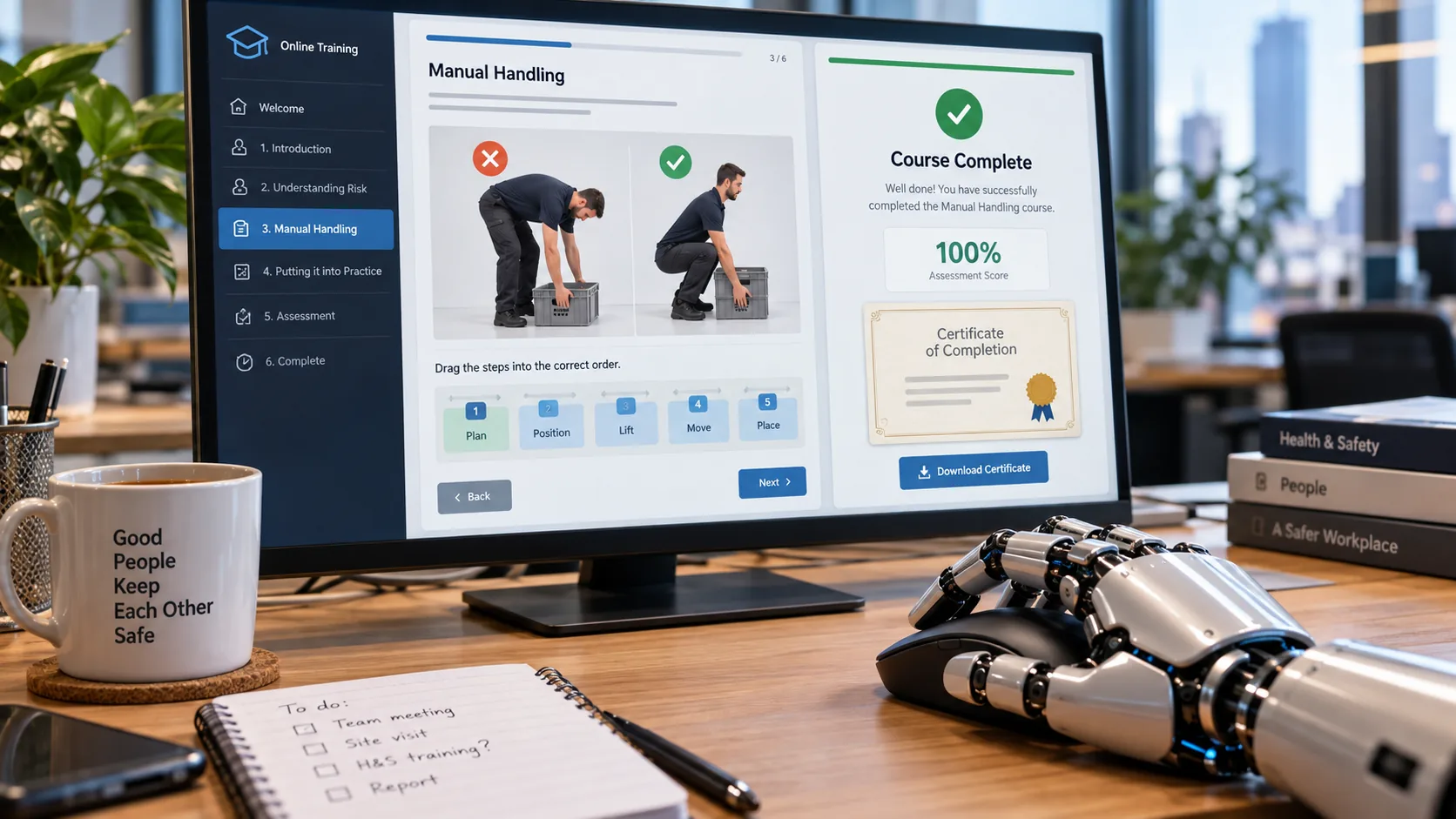
I gave an AI control of a web browser and pointed it at an online manual handling course. I did not help it. I could have popped off to play golf. Instead I sat back with a brew and watched.
It read the slides, completed the drag and drop exercises, answered the assessment questions and finished the course without me touching the mouse. It scored 100%.
An AI cannot lift anything. It has never handled a load. The training platform still recorded it as having passed a manual handling course.
The concern is real. It is that easy.
The burden
The AI did not hack the platform or get around any security. It did what the course asked. It read the information, remembered it and chose the correct answers.
That is a test of recall, and recall is something AI does very well.
So the result tells us more about the course than about the AI. The course was measuring whether someone could remember what the slides said. It was not measuring whether they could lift safely. That was true before AI existed. The test simply makes it visible.
This matters because the certificate goes into the training record. Employers may rely on it, insurers may see it, and after an injury it is likely to form part of the evidence an investigator asks for. It shows the course was completed. It does not show the person understood how to lift safely in their own workplace.
The solution
So I asked the clever little AI bot how to fix it. How should I redesign the course so it could not complete it the same way?
It did not suggest more slides, a timer or harder questions. It suggested asking about the learner’s own work, because that is information it does not have.
Real workplaces are not tidy. Loads are awkward and do not match the textbook example. Teams are short staffed. People take shortcuts at the end of a busy week. In a veterinary practice that might mean moving a 76kg sedated dog from a treatment table. In a glazing factory it might mean loading a 100kg window onto a vehicle with a lifting aid nobody is confident using.
AI answers general questions easily. It becomes less useful when the assessment depends on the learner recognising and explaining their own work.
So the course should ask the learner who they are and what they do. It should show them a photograph of a real task in their own workplace and ask what is wrong with it. It should ask them to mark where the risk is, and to explain in their own words what they would change and why. The core content can stay the same for everyone. The scenarios change to match the job.
The learner is no longer recalling information. They are showing they understand their own work.
Someone could still ask AI for help. But to get a useful answer they would have to describe their workplace, the load and their team in detail. By that point they have at least had to engage with the detail the course is asking them to think about.
The same tool that completed the original course helped design one it cannot complete on its own.
That raises the obvious objection. An off the shelf course cannot do this. It is written once, for everyone, and sold to thousands of organisations. It has never seen your workplace, your loads or your people. It cannot show a veterinary nurse the treatment table in her own practice or a glazier the window on his own truck.
The simple answer is that a generic course can only go so far. It was built to work everywhere, which means it cannot properly reflect what happens in one particular workplace.
What has changed is the cost of building the alternative. A course tailored to one organisation, with its own photographs, its own tasks and its own scenarios, used to take weeks of development and a budget most small employers would never approve. AI can now reduce much of that development time.
AI does the building. It does not decide what good looks like. Which tasks carry the real risk, what a safe lift looks like on that site, and whether a learner’s answer shows understanding are still judgements for a competent practitioner. Without that oversight, you have simply swapped a generic course for a faster one that is just as easy to get wrong.
With it, the course fits the workplace, and the certificate means something.
The outcome
The certificate now records something useful. It shows that a named person looked at their own work, identified the risks and explained what they would do about them. When an auditor, insurer or investigator asks for training records, that is evidence of understanding rather than evidence of completion.
The AI’s suggestions kept returning to one point. The most reliable check is still a competent person watching someone carry out the task. Online training can support that. It cannot replace it.
It cheated the test. It exposed the test. Then it helped fix the test. Poacher, inspector, gamekeeper, before lunch.
A training certificate is not proof of competence. The test is not whether the learner reached the end of the course. The test is whether they understand the task in front of them.
If your training records are mainly completion certificates, that reflects how most online training has been designed. Rebuilding it around the real work your people do is usually a smaller job than it looks.
In the interest of full disclosure, that is exactly what we do. Tailored courses, built with AI, checked by a chartered practitioner who has spent thirty years watching people lift things badly. Shameless plug over.
The AI drafted this. I watched to make sure it didn’t cheat.
If your training file is a stack of completion certificates, a short conversation is usually enough to see what your own training records would show.