Free download: a ready to use health and safety legal register template, pre-loaded with 28 core pieces of UK law. Jump to the template
The problem
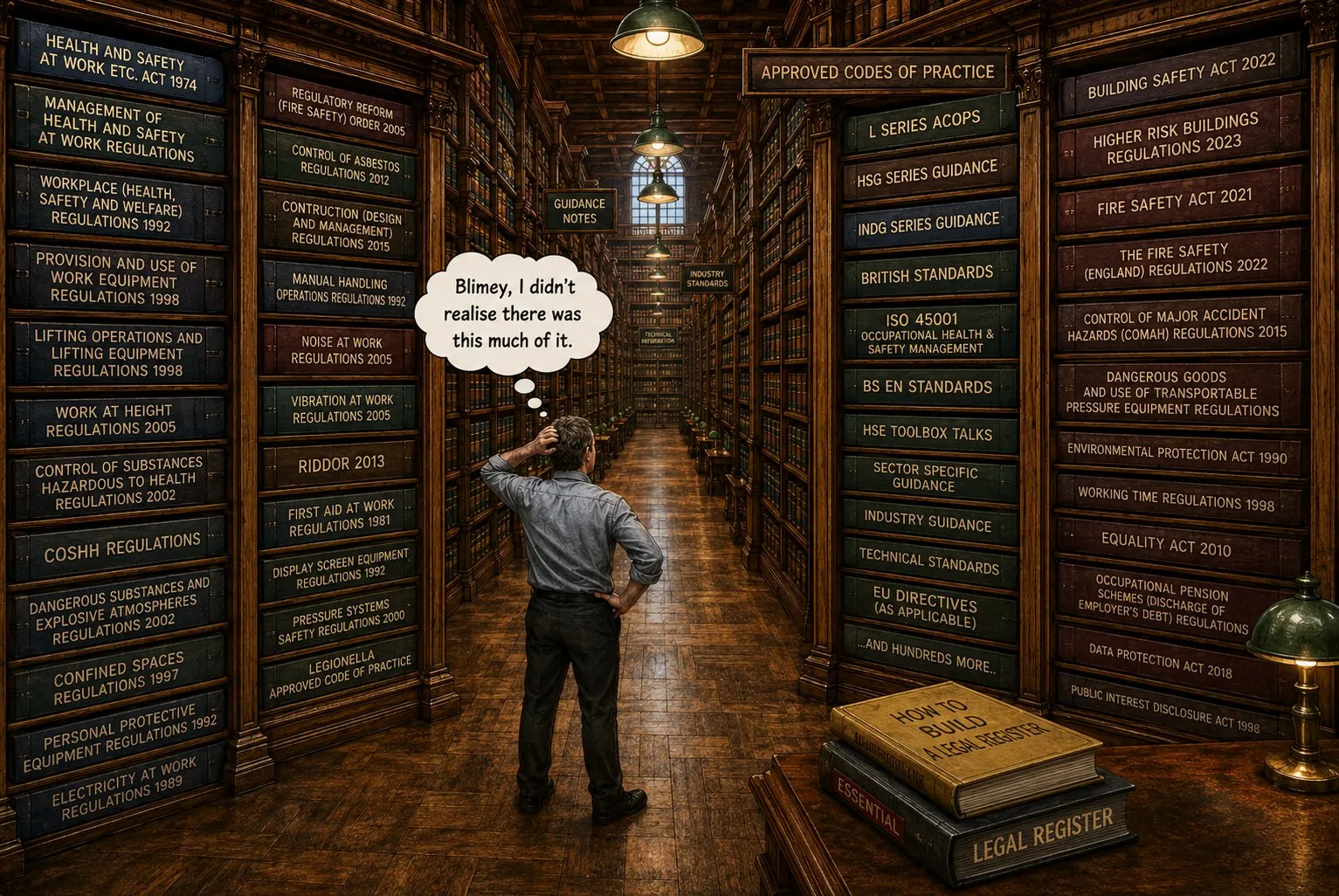
In my experience, most organisations do not have a legal register at all. The ones that do usually have a list.
A column of legislation. A column of dates. Last reviewed. Next review.
It looks like a compliance document.
It proves almost nothing.
A list of legislation tells you what exists. It does not tell you whether you are meeting it, where the proof is, or whether the proof exists at all. It sits in a folder, technically present, practically inert. When someone asks "show me you comply with that," the list has no answer. It was never built to give one.
The reason most registers stop at a list is the same reason they are worth so little. The list is the easy part. There is a lot of law, and writing it down feels like progress. But the question that matters is not what the law says. It is what your organisation has to prove, and where that proof lives.
The burden
A legal register is meant to cover the law that applies to your organisation. Not all of it. Yours.
A register that lists too much is padding. Construction regulations for a business that works from an office. Asbestos duties for a building put up in 2019. It looks thorough and means nobody decided what belongs. A register that lists too little is worse, because the dangerous gap is not the law wrongly included. It is the duty that governs your highest risk and is simply absent, because whoever built the register did not know the operation well enough to see it.
But even a perfectly scoped list, every entry correct, every entry relevant, is still only a list. It still does not tell you whether you comply. That is the real burden. The document most people call a legal register answers the easy question and leaves the hard one untouched.
The solution
This is where the register stops being a list and becomes a spine.
The method runs in three moves. AI removes the blank page. Judgement decides what belongs. And then the register does the job a list never could: it links each duty to the evidence that proves it.
The first move is the draft. Describe your organisation to an AI tool. Sector, activities, premises, equipment, processes, the work people actually do. Ask it to draft the legislation, the regulations, the approved codes of practice and the guidance likely to apply. It returns a structured framework in minutes. That framework is the starting point, and it is useful, because building it by hand from a blank page is what stops many people before they begin. But treat the AI list as a hypothesis, not a source.
The second move is judgement. You verify every entry at primary source, legislation.gov.uk and the HSE directly, because AI does not just miss things. It can invent them, in the same calm tone it uses for the entries that are correct. Then you go down the verified framework and against each one you ask: does this apply to us, and why. If it applies, the reason goes next to it. If it does not, it comes out. And you ask the question the AI cannot answer for you: what do we do here that nothing on this list yet covers. That is answered by knowing the work, not by reading the law.
The third move is what makes it different from every register that stops at a list. You turn each relevant duty into a question of evidence. For this regulation, what proves we comply. A policy, a risk assessment, a maintenance record, a training log, a test certificate. Manual handling becomes a set of questions: where is the risk assessment, where is the training matrix, where are the incident records that show the controls working. The register points you to each.
That third move is where the register earns its name and does a second job at the same time. Every piece of evidence you locate is a document that has to live somewhere. As you build the register, you are building the index of what the filing system must contain. The law points to the evidence, the evidence points to the document, the document goes to its home. The register and the document system are two views of the same thing.
So the AI builds the framework. Knowledge and experience decide what is yours. And knowledge, experience and AI together pull the evidence that proves it. What you end up with is not a list of legislation with review dates. It is a spine built for one organisation, showing what applies, why it applies, and the proof that you meet it.
The outcome
The difference shows the moment someone tests it.
An auditor does not ask whether you own a copy of the regulations. They ask you to prove you comply with one. A list answers the first question and freezes on the second. A register built this way answers straight away, because the evidence was the point of building it, and the evidence is already linked and already filed.
It also exposes the dangerous gap before an incident does. Working a register for evidence means reading every duty and asking "can we actually prove this." That is the pass that finds the duty with no evidence behind it, the compliance you assumed but cannot show. You do not find that by adding more law. You find it by tracing each duty to its proof and seeing where the proof is missing.
Give it an owner and a review date and it stays current. Much of the law that affects business changes on set dates each April and October, so an owner watching those dates catches the change before the auditor does.
A legal register built this way does what a list never could. It tells you the truth about what your organisation is required to do, why each duty applies, and where the proof that you meet it lives. That is not a document you file and forget. It is the spine the whole compliance system is built on.
Organisations rarely fail an audit because they cannot find the law. They fail because they cannot find the evidence.
What a health and safety legal register should contain
A register that holds under scrutiny answers five questions for every entry: what the law is, why it applies to you, what it requires you to do, what proves you do it, and where that proof is kept. Add an owner and a review date and it stays true. Here is what three entries look like for a typical small employer.
| Legislation | Applies because | Duty | Evidence and where it lives |
|---|---|---|---|
| Health and Safety at Work etc. Act 1974, s.2(3) | Five or more employees | Written health and safety policy, brought to employees' notice | Signed policy statement, organisation and arrangements, staff briefing record. Hub folder 01. |
| Management of Health and Safety at Work Regulations 1999, reg 3 | All employers | Suitable and sufficient risk assessment, significant findings recorded | Risk assessment register, signed assessments, review log. Hub folder 03. |
| Manual Handling Operations Regulations 1992, reg 4 | Staff lift and move stock | Avoid, assess and reduce hazardous manual handling | Manual handling assessments, training records. Hub folders 03 and 06. |
Notice what the last column does. Every entry points to a document, and every document has a home. That is the difference between a register that proves compliance and a list that only names the law.
Health and safety legal register template
The method in this article, built into a working spreadsheet. Download it, go down the list, and you have the start of a register that proves compliance.
- Pre-loaded with 28 core pieces of UK health and safety law, each with key provisions, a plain duty summary, typical evidence and a link to the source
- Mark what applies, record why, and log the evidence you hold and where it is kept
- Review dates and overdue flags calculate themselves; status is colour coded
- A live summary tab showing what applies, what is compliant and what is overdue, plus a change log
Rather have one built for you? A template is a starting point. We build bespoke legal registers for your organisation: scoped to your activities and sites, every duty verified at source, each one linked to the evidence you hold, and the gaps shown plainly. Then we keep it current.
Legal register questions
What is a health and safety legal register?
A record of the health and safety law that applies to your organisation, why each piece applies, what it requires you to do, and the evidence that shows you do it. Done properly it is the spine of the whole compliance system, not a list of Acts.
Is a legal register a legal requirement?
No single UK regulation requires a document called a legal register. You must comply with the law that applies to you, though, and you cannot show that without knowing what it is. If you work to ISO 45001, clause 6.1.3 requires you to determine your legal requirements and keep documented information on them, which in practice means a register.
How often should a legal register be reviewed?
At least once a year, and whenever your activities change or the law does. Many legal changes take effect on the common commencement dates in April and October, so an owner who checks then will catch most changes before an auditor does.
Can AI build a legal register?
AI can draft the framework in minutes, which removes the blank page. It can also miss law or invent it in the same confident tone, so every entry has to be verified at source on legislation.gov.uk and hse.gov.uk, and the judgement about what applies to you stays with a competent person.
If your own legal register is a list and nothing more, that is not a failing. It is where most start. Turning it into something that proves compliance is the part we can take off your hands.
If you have read this far, you may already be wondering what your own register would show. A short conversation is the easiest way to find out.